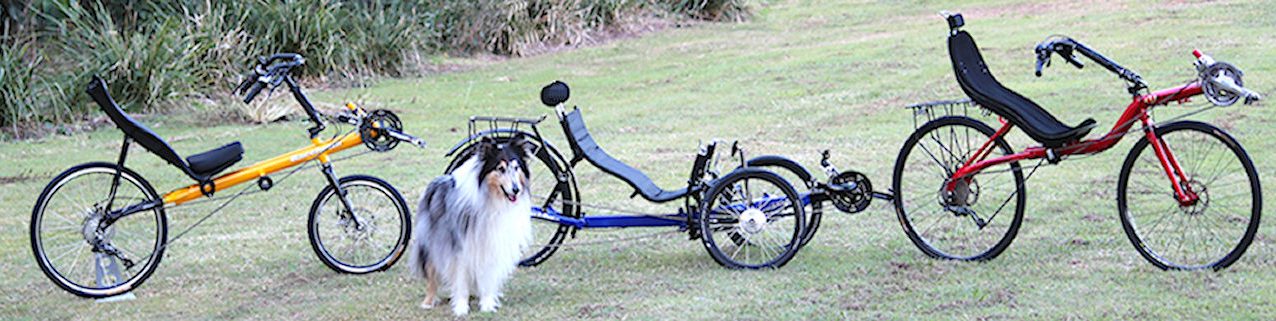
After two committee sittings and thousands of submissions from QLD cyclists, the new Queensland E-mobility Bill passed in Parliament on the 4th June 26, and it will have an impact on the Recumbent e-cycle community. This post is really aimed at Queenslanders, but other state residents should probably take notice and pay attention to what your legislators are thinking!
Key Takeaways (also see links at end of document):
- Drivers licence required for operation of e-assist pedal cycles and personal mobility devices (PMD). Effective 31 August 2026.
- EPAC Speed limits introduced for e-assist cycles of 12kmh on footpaths and when passing pedestrians on shared paths. Existing speed limits for bikeways and shared paths remain unchanged.
- PMD speed limits introduced of 12kmh on footpaths and when passing pedestrians on shared paths, or 25kmh otherwise. Effective 1 July 2026
- The definition contained in the Act (Schedule 4) of a power assisted bicycle changes to only recognise EN15194 Electrically Power Assisted Cycles (EPAC) compliant cycles. Recumbent and Semi-recumbent EPAC’s cannot meet this standard (see below for further details). Effective 1 July 2026.
- The Regulation is changed to more narrowly define an EPAC as meeting the standard current at time of manufacture. This impacts trikes, as the current EN15194 standard only recognises two wheel bicycles. E-assist trikes become illegal for road and related area use. Effective 1 July 2026 with transition period to 28 Feb 2027 for compliance.
- Legacy and Special Purpose EPAC provisions created. Existing e-trikes will need to have compliance proved under the legacy provision, future trikes under the special purpose provision. Effective 28 Feb 2027.
First we should cover a bit of history and the present laws to set the scene a little. As part of this we’ll be looking at the various acts and regulations of our laws and that does need looking at words with a certain narrow view with respect to the meanings of words defined in law, and not the more common use meanings.
Road Vehicle Standard
To start we’ll look at the Australian Federal Road Rules, specifically the Road Vehicle Standards (Australian Design Rules). The dictionary attached to the ADR’s defines power assisted pedal cycles. As of today, there are two classes. A 200 watt class, and over 200 watts. Both share common requirements of being pedal activated, speed limited, throttle control of no more than 6kmh.
The over 200 watt group is called an Electrically Power Assisted Cycle (EPAC) and is presently very simple requiring:
- pedal activation
- motor power limited to 250 watts continuous power
- motor power to cut off at 25kmh
- if fitted a throttle that it is speed limited to 6kmh
Simple.
The Road Vehicle Standard does not define a bicycle. That is left to the States and Territories. The corollary to this is that a bicycle is not a road vehicle, but a power assisted cycle is. This is an important distinction when it comes to importation of e-assist pedal cycles.
Bicycle Definition
In the Queensland State Legislation a bicycle is both defined and, by regulation, permitted to be used on road and related areas.
The “bicycle” definition is written:
“a vehicle with 2 or more wheels that is built to be propelled by human power through a belt, chain or gears, whether or not it has 1 or more auxiliary motors…”
and further adds power assisted bicycle, and EPAC. Part 353B of the Transport Operations (Road Use Management—Road Rules) defines an EPAC and points to the Road Vehicle Standards for details.

The EN15194 Standard
Much reference has been made to the European Standard EN15194 as the accepted guide for e-assist cycles so we’ll have a brief look at that too.
The EU regulates its industry and commerce with a raft of different regulation, a portion of these being called Machinery Directives. EN15194 was written to gather in one place all the requirements applicable to e-bikes, and the initial issue was in 2009. This initial issue covered the performance and basic electrical requirements for e-bikes. Time passes, and the current version encompasses much more detail, including the mechanical requirements and structural testing of the frame. The EN standard was written as a voluntary standard to help manufacturers more easily comply with the EU’s legal framework.
EN15194:2017+A1 is specifically written around city and trekking bicycles,. It further defines what a bicycle is in reference to the standard – directly stating 2 wheels. The clue is in the name: Electrically Power Assisted Cycles – EPAC Bicycles.
The immediate impact is that tricycles cannot meet the requirements of this standard simply because they have more than 2 wheels. There are a whole lot of additional requirements in the standard that recumbent trikes cannot meet also.
Recumbent trike manufacturers for the EU market have typically not complied with any version of EN15194, preferring to manage their approvals via the various applicable machinery directives. This has been and still is perfectly acceptable for the EU market.
The QLD E-Mobility Bill 2026
More properly: Transport and Other Legislation (Managing E-mobility Use and Protecting Our Communities) Amendment Bill 2026.
Onto the new Queensland Bill passed in Parliament on the 4th June 26. The Bill and it’s 122 amendments introduces broader police powers, requirements for drivers licences, speed limits, and standards for e-mobility devices (PMD’s) and e-bikes. I’m not going through the whole bill in this document. Instead I will concentrate on the impact to recumbent trikes primarily. If you wish to read the bill and amendments – and you should, if only to get a sense of how complicated it is – be aware that the bill amends multiple Acts of Parliament plus different regulations. Let’s just say it is challenging to work out what is being amended!
The biggest impact for recumbent trike riders is the change in EPAC definition. It removes the reference to the Road Vehicle Standard and introduces mandatory compliance with the latest version of EN15194 for new cycles after July 1st, 2026 as being the legal standard for EPAC bicycles in Queensland. For manufacturers this moves the compliance from being voluntary (for sales in Europe) to mandatory for use in Queensland. No, I don’t know how this will be policed either.
The introduction of the new version of part 353B also removes the lower power (200 watt) assist option.
Fortunately for the owners of the thousands of presently legal e-bikes that comply with previous issues of EN15194 and have a suitable label attached, they will be automatically accepted as complying. Naturally that does not help trikes.

Legacy and special purpose EPAC
The Bill amendment introduces two new categories:
- Legacy EPAC, and
- Special Purpose EPAC
Legacy EPAC is for presently compliant e-assist cycles that were built prior to 1 July 2026 (ie not EN15194 compliant but legal by the present legislation), and the special purpose EPAC is for anything post 1 July 2026.
The special purpose EPAC contains the clause:
“is designed or modified to enable a person with a disability or medical condition to ride the vehicle”
So the days of fitting a DIY kit to your favourite MTB appear to be over.
Note that the EN15194 standard does not specifically allow a hand throttle. Instead there is a “start-up assistance mode”, the actuation of which is only defined as a ‘voluntary and maintained action by the user’. Manufacturers typically use a “push and hold” of one of the control buttons to engage the start-up mode. Consequently the presence of a hand (or thumb) operated throttle is a sign to enforcement officers of a potentially illegal cycle.
How this Legacy and Special Purpose approval will work is a complete unknown. The bill amendment merely states in Part 7B 122S EPAC verification rules:
“The chief executive may make rules (EPAC verification rules) about verifying that a vehicle is a legacy EPAC or special purpose EPAC”.
These rules are not written yet, and will be created without Parliament’s oversight and will be approved by the Minister.
There is obviously potential for high profile police operations when the new rules become law and a trike with a visible hand throttle may attract unwelcome questions.
Although the new rules come into force in July, there is a transition period until 28 Feb 2027 for the compliance with the Legacy and Special Purpose EPAC approval.
An interesting anomaly is that there is no actual restriction on the sale of non-compliant e-cycles, other than not to be sold to a person under 16 years old.
Speed and Licence
Other parts of the bill introduce licence requirements and speed limits for EPAC and PMD’s.
A driver’s licence is now going to be a requirement for operation of an EPAC and PMD, for those people unable to hold a drivers licence there will be a provision for a special permit of some kind, how this is to work is yet unknown.
Speed limits for EPAC it will be 12kmh on footpaths, and 12kmh when passing pedestrians on shared paths. Of course EPAC has the power cut off at 25kmh but there is no restriction on pedaling faster!

Importation, and NSW
And a bit of a final comment on importation, and the changed requirements in NSW.
Currently, road vehicles are regulated imports and permits or approvals are required before a vehicle may be imported. Since e-assist cycles appear in the road vehicle standards they are naturally grouped as road vehicles for importation. Fortunately (or not), EPAC complying with EN15194:2017+A1 have been determined to not be road vehicles and can be imported without permits. Annoyingly that still makes e-trikes a controlled import.
New South Wales has recently introduced rules controlling the sale of e-bikes and e-mobility devices. E-bikes must meet (and be certified by an Australian based organisation to meet) certain clauses of EN15194:2017+A1, plus have a battery meeting certain standards. Approved for sale EPAC’s are listed on the NSW Gov website. There are no recumbents listed. On top of this, NSW have determined that the EPAC standard for use on NSW roads is EN15194:2017+A1, effective now for new cycles (by the regulated sale) but with a transition period of 3 years for previously legal cycles to be removed from service. There is no pathway at present for anything other than EN15194:2017+A1 compliant 2 wheel bicycles.
Queensland Riders Recommendations
Given the great number of unknowns, our recommendation to e-trike riders is to continue to ride as normal while keeping a close watch on developments, but do consider whether a hand throttle is necessary.
We will be keeping a close eye on developments and will post updates on our website and facebook page. In the meantime we are investigating several options for future approvals.
Links:
“Transport and Other Legislation (Managing E-mobility Use and Protecting Our Communities) Amendment Bill 2026”,:
https://www.legislation.qld.gov.au/view/html/inforce/current/sl-2009-0194#sec.353B – Transport Operations and Road Use Management regulations (sect 353B EPAC definition)
https://www.legislation.qld.gov.au/view/html/inforce/current/act-1995-009#sch.4 – Transport Operations and Road Use Act Sch 4 Dictionary – Bicycle definition.
https://legislation.nsw.gov.au/view/pdf/asmade/sl-2026-118 – Electric Bicycles amendment 27 Mar 2026
Importing – vehicles that are not road vehicles:
H James, if a “Special Purpose EPAC” “is designed or modified to enable a person with a disability or medical condition to ride the vehicle”, this would render all e-trikes stock recumbent e-trikes designed for general public use as illegal e-bikes (trikes), true?
Hi Peter,
The wording is poor and I think open to interpretation but on balance I don’t think it will be an issue. “Designed to enable” is not the same as “designed solely for” which would indeed be a problem.
I’m aware the wording has been queried with respect to the writing of the special purpose EPAC verification regulations, whether that makes a difference or not is another story!